Bioma is a personalized gut health supplement brand that’s blown up in popularity over the past few months. The company claims that since your gut is unique, your probiotic supplement should reflect that.
But does Bioma actually sell personalized supplements, or is this a marketing gimmick? Does Bioma contain research-backed ingredients for gut health? Does it contain any unhealthy ingredients? And is Bioma better or worse than popular gut health supplements like Metamucil?
In this article we’ll answer all of these questions and more, as we analyze the ingredients in Bioma to give our take on whether or not the supplement is likely to be effective for enhancing gut function, and whether or not it's healthy overall.
We’ll also share our concerns about the company’s health quiz and "personalized" results, discuss the risk of side effects, and compare Bioma to other popular gut health supplements to pick our winners (and losers).
Key takeaways:
- "Personalized" approach may be unscientific
- We consider Bioma's supplement likely to support optimal gut health
- We do not currently recommend Bioma
Is Bioma Actually Personalized?
As highlighted below, the Bioma website strongly suggests that the brand sells personalized supplements that are unique (or at least tailored) to each customer:

image source: bioma.health
Claiming that “your probiotics should reflect that” your gut is unique made me think that after completing the gut quiz, I would be eligible for a supplement tailored specifically based on the answers submitted.
However, that may not be the case.
I completed the Bioma gut quiz twice with entirely different answers (one set of responses focused on bloating and the next set focused on fatigue).
However, the ingredients in the supplement after completing the quiz with entirely different answers were exactly the same.
Also, the supplement is sold on Amazon with one formulation.
This makes sense in practice but strikes us as a questionable marketing strategy. It would be nearly impossible for a supplement company to manufacture a unique supplement for every customer, but if Bioma only sells one formulation, they should make that more clear to be fair to their customers in our opinion.
We also take issue with the “diagnoses” created by Bioma after the quiz is completed.
Bioma is a supplement company, not a healthcare company, and gut inflammation is diagnosed with medical testing, not with user-submitted online quizzes.
This is an unscientific approach in our opinion, and consumers with supposed gastrointestinal disease should speak to a doctor about their symptoms rather than try to resolve them with online quizzes.
Ingredient Analysis
The ingredients in Bioma are shown below:
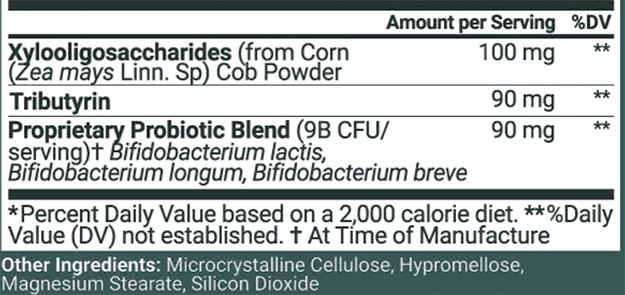
Xylooligosaccharides are a research-backed prebiotic ingredient, but we can’t find any medical evidence they’re effective at a dose as low as in Bioma.
In fact, Bioma’s own scientific references page cites studies that use much higher doses than included in their own supplement. One of the medical reviews cited by the brand concludes the following:
“[Xylooligosaccharide] supplementation may be beneficial to gastrointestinal microbiota and 2.8 g per day may be more effective than 1.4 g per day.”
2.8 grams (g) is 28x the dose in Bioma.
Tributyrin is a triglyceride that’s clinically shown to have anti-inflammatory effects in the gut, as we documented in our review on the best probiotics for women.
Proprietary Probiotic Blend is the final active ingredient, and contains a total dose of 9 billion colony-forming units (CFUs), which is within the typical dosing range according to a Fact Sheet on probiotics published by the National Institutes of Health.
A specific strain of Bifidobacterium lactis, which is a probiotic species in Bioma, is clinically shown to improve gastrointestinal symptoms after antibiotic treatment.
The inactive ingredients in this formulation are likely safe and non-toxic.
Overall, we consider Bioma likely to support optimal gut health. We take issue with the way this company markets their supplement, but we have no concerns with the supplement's formulation.
This is a better-quality gut health supplement than the average gut health supplement we’ve analyzed to date on Illuminate Health.
Does Bioma Cause Side Effects?
Bioma doesn’t appear to have been studied in any clinical trials, which makes it more challenging to determine whether or not the supplement is likely to cause side effects.
However, we can make an educated guess based on its ingredients.
Xylooligosaccharides were shown to cause nausea and vomiting at high doses in an animal study published in the Regulatory Toxicology and Pharmacology journal, but we would not consider the dose in Bioma nearly high enough to cause that effect.
Probiotics can cause minor digestive side effects like gas and bloating in some people in the early stages of use, as we documented in our Bye Bye Bloat reviews article, but the probiotic dose in Bioma is moderate and we consider this side effect to be unlikely in otherwise healthy adults.
The Bioma website mentions that bloating may be a temporary side effect.
Bioma vs. Popular Gut Health Supps
Here's how Bioma compares to other popular gut health supplements in terms of potential effectiveness and healthiness, in our opinion:
Metamucil
Brand was recently sued over allegedly containing lead levels around 27x threshold limits.
Also contains unhealthy flavoring ingredients like artificial flavor, which is clinically shown to be harmful (at least in animal studies).
Winner: Bioma
Supergut
Supergut is a prebiotic supplement that markets itself as "Nature's Ozempic."
The supplement contains flavoring additives and a synthetic vitamin and mineral blend that we consider potentially unhealthy.
Although we have concerns about Bioma's marketing tactics, we consider Bioma's supplement to be a higher-quality formulation than Supergut.
Winner: Bioma
Bio Complete 3
Most ingredients have research backing, but there was an ingredient disclosure issue at the time of our last analysis, which is a consumer safety issue.
At least with Bioma, you know the full list of ingredients in the supplement.
Winner: Bioma
Our Clean Gut Health Picks

MBG Organic Fiber Potency+ is our top gut health supplement.
MBG Organic Fiber Potency+ contains 100% soluble fiber, which was described as "one of the most important nutrients for the gut microbiota" in a clinical review published in the Molecules journal.
Manukora MGO 850+ is our top whole food gut health pick.
A 2024 clinical trial reported that manuka honey ingestion "correlates with beneficial modulation of gut microbiota composition."
Both of the products recommended in this section are free of ingredients that we consider to be unhealthy.
Bioma Pros and Cons
Pros:
- Effective formulation
- Should support optimal gut health
- Research-backed probiotic dose
- No unhealthy additives
- Contains prebiotics and probiotics
Cons:
- Questionable marketing practices
- Doesn’t appear clinically tested
- Hard to find unsponsored customer reviews online
- Xylooligosaccharides may be underdosed