HexClad is a cookware company that describes its products as "hybrid cookware." The brand claims that their products provide the benefits of stainless steel, cast iron and non-stick pans all in one.
But is HexClad really a better option than a standard non-stick pan? Does it contain any potentially unhealthy materials? How does HexClad compare to cast iron pans? And why was the brand sued over its materials?
In this article we'll answer all of these questions and more, as we review clinical studies on non-stick pans to explain why we consider them to be unhealthy.
We'll share our opinion about whether or not HexClad is a healthier option than traditional non-stick, explain why the brand was sued, and compare HexClad to other popular non-stick pans like GreenPan to pick our winners (and losers).
Key takeaways:
- Non-stick pans contain chemical compounds harmful to human health
- We can't identify which non-stick chemicals are used by HexClad
- We do not currently recommend HexClad
Are Non-Stick Pans Unsafe?
Most cooking pans you’ll find in big-box retailers are “non-stick,” meaning they contain synthetic chemical coatings on the cooking surface which allow food to cook without sticking to the pan.
This technology is convenient but medical research suggests it may be harmful to human health.
A 2017 medical review found that non-stick cookware coated with polytetrafluoroethylene (PTFE), more commonly known as Teflon, presented significant toxicity concerns due to the chemicals used, and that newer versions of non-stick materials weren’t necessarily any less toxic than older ones.
As we discussed in our Gotham Steel reviews article on another cookware brand, a variety of non-stick compounds have been shown to be potentially harmful to human health, and we're unable to identify any definitively proven to be safe.
Another review published in the Social Studies of Science journal concluded that there’s not nearly enough safety data to show that the chemicals used in non-stick coatings are safe for consumers.
The above-linked review described the use of these chemicals as an “issue of social and scientific concern.”
We do not recommend non-stick cookware, and it seems illogical in our opinion to purchase non-stick cookware when there are alternatives that are free of this potentially harmful chemical coating.
Is HexClad Safer?
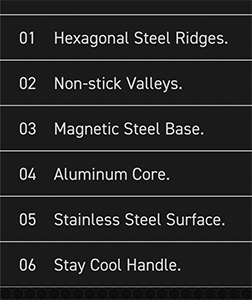
HexClad’s base contains two layers of steel covering a layer of aluminum. These are high-quality cookware materials.
However, we have concerns about the "Non-stick Valleys" described below:
Stainless steel is one of the most popular cookware materials for good reason: it’s stable at high temperatures and relatively non-toxic.
There is some medical research suggesting stainless steel cookware can leach nickel, but the researchers suggest the levels shouldn’t be a problem in regular, non nickel-sensitive individuals.
Aluminum may be a health concern when absorbed by the body, as we discussed in our Dr. Squatch review, but since the aluminum in this product is lined with stainless steel it shouldn’t leach into food.
HexClad doesn’t make clear whether the aluminum they use is anodized. This is a process ensuring the metal won’t leach into foods, so it’s typically recommended for cookware. We urge HexClad to publish this information.

PTFE is the chemical coating used in the "Non-stick Valleys" in HexClad pans.
This is the most common non-stick coating used on commercial pans. It’s very effective, but its safety is questionable as we discussed in the previous section of this article.
We do believe that PTFE is safer than perfluorooctanoic acid (PFOA), which is a different compound found in non-stick cookware.
It appears that the same technology and materials (including non-stick coatings) are used for all of HexClad's products: pans, woks and pots. For this reason our general comments apply not only to the pans but to all of their products.
While we consider HexClad to be a superior option to the average non-stick pan which may be made with PFOA, we do not recommend it overall due to the use of PTFE.
HexClad Sued over Materials
In 2023, HexClad was sued in a class-action lawsuit filed in the state of California.
According to Top Class Actions, the plaintiffs alleged that the company was engaged in deceptive marketing, because of the PFAS-free claim.
The lawsuit alleges that HexClad product(s) do actually contain some levels of PFAS, because PTFE is a type of PFAS.
At the time of updating this article, the lawsuit appears to be ongoing.
This information is concerning to us, because as described in the material review sections above, we consider PFAS to be potentially toxic to humans.
HexClad vs. Popular Non-Stick Pans
Here's how HexClad compares to other popular, newer-generation non-stick pans in terms of healthiness, in our opinion:
GreenPan
The brand's Technology page fails to specifically describe the chemical compounds used to create non-stick effect.
From a functionality perspective, we give this brand the slight edge because we tested it and enjoyed the experience, and it's cheaper than HexClad.
Winner: GreenPan
Caraway Cookware
Our primary concern with this brand is the same as with HexClad: unclear non-stick chemicals.
Caraway Cookware is made from ceramic, so it gets the slight edge due to the lack of aluminum.
Winner: Caraway Cookware
Gotham Steel
Made from titanium and ceramic as the base materials.
We have similar non-stick compound concerns, but the lack of aluminum gives it the slight healthiness edge.
Winner: Gotham Steel
Our Clean Cookware Pick

Lodge Seasoned Cast Iron Skillet is our top cookware pick.
It's free of any questionable chemical coatings. The only material is cast iron.
We consider cast iron pans to be the safest and healthiest cookware option. Cast iron has been used for thousands of years and is non-toxic.
Cast iron pans are made primarily from iron and steel, and are somewhat naturally non-stick because of the effects of fat heated on the cooking surface over time.
We recommend purchasing some Lodge Pan Scrapers along with the pan.
They're only $4.90, and cast iron pans can be challenging to clean for the first few uses without scrapers, before the pan becomes seasoned.
HexClad Pros and Cons
Pros:
- Aesthetically-pleasing design
- Performs well functionally according to some customer reviews
- Brand's website offers free shipping
- Stainless steel is a high-quality base material
- Most online customer reviews are positive
- Healthier than non-stick pans with PFOA
Cons:
- Expensive
- Company recently sued over allegations of PFAS contamination
- Contains PTFE
- Unclear if aluminum is anodized