Simpler Hair Color is a brand that's marketed as a healthier alternative to traditional hair dye. The company's website claims their products are "The Easiest Way To Eliminate Grey."
But does Simpler Hair Color contain research-backed ingredients for changing hair color, and improving hair quality? Does it contain any unhealthy ingredients? Is Simpler Hair Color better or worse than popular "healthy" hair dye brands like oVertone? And does it cause side effects?
In this article we'll answer all of these questions and more, as we analyze the ingredients in Simpler Hair Color to give our take on whether or not it's likely to be effective, and whether or not it's healthy.
We'll also discuss the risk of side effects, and compare Simpler Hair Color to traditional hair dye and other popular "healthy" hair dye brands like oVertone to pick our winners (and losers).
Key takeaways:
- Should be effective because it contains proven hair colorant chemicals
- Contains two ingredients we consider to be unhealthy
- We do not currently recommend Simpler Hair Color
Ingredient Analysis
The ingredients in Simpler Hair Color Natural Black are shown below:

1-hydroxyethyl 4,5-diamino pyrazole sulfate and 2,4 diaminophenoxyethanol dihydrochloride are hair colorants, so we consider this product likely to be effective for coloring the hair black.
There are some other active ingredients in this formulation that have research backing for improving hair quality.
Hydrolyzed wheat protein was shown in a 2018 medical review to have a natural hair conditioning effect.
Aloe vera can hydrate and support optimal scalp health, as we discussed in our article on is Herbal Essence good for hair.
There are also some ingredients in this formulation that we find somewhat concerning from a health perspective.
Toluene-2-5-diamine sulfate was described as a "potent immune activator" that may have pro-inflammatory effects in a clinical trial published in the British Journal of Dermatology.
Sodium sulfite was shown to be toxic to human cells in a 2020 in vitro clinical trial.
Overall, we don't currently recommend Simpler Hair Color due to our health concerns about the inactive ingredients discussed above.
Simpler Hair Color vs. Traditional Hair Dye
Most hair dye products that we've come across in our research have contained ingredients that we deem to be questionable from a health perspective.
Traditional hair dye has been clinically shown to contain "potent" cancer-causing compounds according to at least one medical review that we documented in our oVertone reviews article.
Consider the ingredient list below from Revlon Black hair dye:
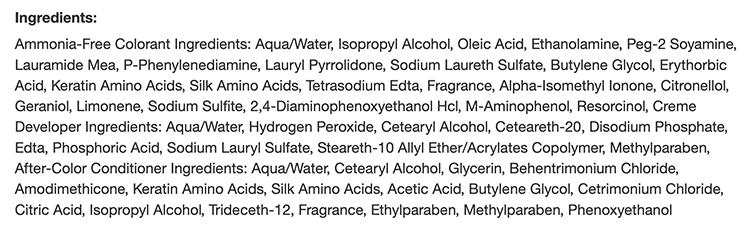
Fragrance is referenced twice, and is clinically shown to be detrimental to human health.
Ethylparaben and methylparaben are part of a class of compounds called parabens, and a 2023 medical review on parabens concluded the following:
"Parabens could disturb the endocrine system by activating the [estrogen receptors] and disrupting the steroid hormone synthesis and secretion, suggesting their potential deleterious risks to the environment and human health."
P-phenylenediamine was shown to be allergenic in a medical review published in the Dermatitis journal.
Based on their active ingredients, we consider most commercial hair dyes to be functionally effective (meaning they will successfully change hair color), but we consider Simpler Hair Color to be a healthier option than most commercial dyes like Revlon.
Does Simpler Hair Color Cause Side Effects?
Simpler Hair Color doesn't appear to have been studied in any clinical trials, which makes it more challenging to assess the risk of side effects.
However, we can make an educated guess based on its ingredients.
Ethanolamine, which is an ingredient in some Simpler Hair Color formulations, was the subject of lawsuits regarding hair loss as we documented in our review of hair care brand Madison Reed.
A 2012 medical review described ethanolamine as having the potential to cause hair loss.
This is something that potential consumers may wish to discuss with their dermatologist.
There are no other ingredients in Simpler Hair Color that we can identify as having a risk of side effects.
There is no mention of side effects on the Simpler Hair Color FAQ page at the time of publishing this article.
Simpler Hair Color vs. "Healthy" Dyes
Here's how Simpler Hair Color compares to other "healthy" hair dye brands in terms of healthiness, in our opinion:
oVertone
Contains synthetic dyes like Red 40 and Basic Blue 99.
Synthetic dye is clinically shown to have negative health consequences, and can be absorbed through skin and lungs into the bloodstream.
Simpler Hair Color is the healthier choice.
Winner: Simpler Hair Color
Madison Reed
Madison Reed Hair Color contains fragrance, which is clinically shown to have harmful health effects.
This brand has also been sued over allegations that their products caused hair loss.
Simpler Hair Color has the advantage from a health and safety perspective.
Winner: Simpler Hair Color
Naturtint
Healthier formulation than traditional hair dye, but still contains fragrance.
Simpler Hair Color is the healthier choice.
Winner: Simpler Hair Color
Simpler Hair Color Pros and Cons
Pros:
- Healthier than traditional dyes
- Healthier than most "healthy" hair dye competitors
- Should effectively dye hair
- Fragrance-free
- Artificial-dye-free
Cons:
- Contains toluene-2-5-diamine sulfate
- Contains sodium sulfite
- Contains ethanolamine