Peptiva is a sleep supplement that's sold by a company called Adaptive Health. The supplement contains probiotics, which is unique for a sleep supplement, and the brand claims customers can "Restore Balance As You Sleep With Peptiva!"
But does Peptiva contain research-backed ingredients for improving sleep? Does the supplement contain any unhealthy ingredients? What was our Product Tester's experience using Peptiva for a month? And does it cause side effects?
In this article we’ll answer all of these questions and more, as we analyze the ingredients in Peptiva to give our take on whether or not the supplement is likely to be effective for improving sleep quality, and whether or not it's healthy.
Because this supplement contains many active ingredients, we’ll break our Ingredient Analysis down into three sections: Probiotics, Other Active Ingredients, and Inactive Ingredients.
We'll also share our Product Tester's honest experience purchasing and testing Peptiva for a month.
Key takeaways:
- Contains two ingredients we consider effectively-dosed for sleep support
- Contains one inactive ingredient we consider unhealthy
- We do not currently recommend Peptiva
Probiotic Ingredient Analysis
The probiotic ingredients in Peptiva are shown below:

This supplement provides a total probiotic dose of 26 billion colony-forming units (CFU).
Four of the included probiotic strains are of the Lactobacillus species, including Lactobacillus acidophilus (ATCC SD6865) and Lactobacillus acidophilus (ATCC SD6866).
We cannot identify any medical research suggesting that Lactobacillus probiotics are effective for improving sleep quality.
In fact, a medical review published in the Alternative Therapies in Health and Medicine journal searched for studies suggesting that Lactobacillus probiotics were effective for supporting sleep, but the study authors couldn't find any.
The two other species of probiotics included in this formulation are Bifidobacterium strains, and again we cannot identify any medical studies suggesting them to be effective for sleep.
We do not consider this blend likely to improve sleep.
Other Active Ingredient Analysis
The other active ingredients in Peptiva are shown below:

GABA appears to be an effective ingredient for enhancing sleep.
A medical review published in the Frontiers in Neuroscience journal analyzed data from 14 clinical trials on GABA and sleep, and concluded the following: “doses ranging between 100 and 300 mg seems to be efficacious in reducing sleep latency with prolonged use of 1–4 weeks.”
The GABA dose in Peptiva is 100 milligrams (mg), so we’ll consider this an effective ingredient and dose.
Melatonin is one of the most well studied and safe ingredients for enhancing sleep quality and reducing time-to-sleep, as we discussed in our review of Relaxium.
The 1.5 mg total melatonin dose in Peptiva is effective based on a 2019 meta-study, which documented the therapeutic dosing range as 1 mg to 6 mg.
Valerian extract is another research-backed sleep enhancer, but may be underdosed in Peptiva.
A meta-study analyzed data on valerian extract and sleep from 16 clinical trials. The researchers found the supplement to be effective, but the minimum dose used in any of the trials was 225 mg daily. Peptiva contains only 50 mg.
Overall, we consider this blend to be effective for supporting optimal sleep quality.
Inactive Ingredient Analysis
The inactive ingredients in Peptiva are shown below:

Carrot concentrate is a natural colorant that's a much healthier option than artificial dye in our opinion.
Titanium dioxide is used for its white color, but this ingredient is banned in the EU for use as a food additive due to concerns over genotoxicity. This means that this additive can potentially damage DNA.
We always recommend avoiding ingestible titanium dioxide.
We Tested Peptiva
One of our product testers named Jodie Steinberg used an inositol supplement before sleep for 30 days. Here's her experience:
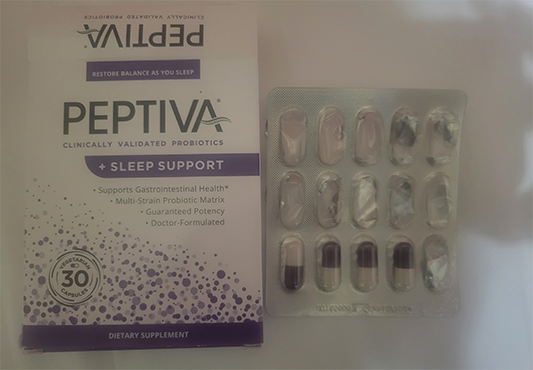
The product was easy to use. The pills are contained in an easy push-through foil.
The pills are tasteless and odorless.
If you are someone who has problems staying asleep like me, I did not find this product to be helpful with that. Although it contains a time-release melatonin, I still woke up in the middle of the night each time I used it.
I liked that it did not contain too much melatonin like a lot of other products on the market.
I am a trouble sleeper so I am not going to say the product did not work because a couple of nights it did work for me. I did not feel as though the additional ingredients did anything extra to promote sleep beyond what melatonin would typically do.
I didn't experience any side effects using Peptiva.
Overall, this is a product I would consider purchasing in the future, and I'd rate it 7/10.
Does Peptiva Cause Side Effects?
Peptiva doesn't appear to have been studied in any clinical trials, which makes it more challenging to assess whether or not the supplement will cause side effects.
However, we can make an educated guess based on its active ingredients.
GABA has a favorable safety profile, but changes in its levels "are involved in the development of numerous neuropsychiatric disorders" according to a medical review published in the Current Pharmaceutical Design journal.
This does not necessarily prove that GABA supplementation has this effect, as it could be merely correlative (meaning that changes in GABA levels may be caused by the development of psych disorders rather than the reverse effect).
That being said, it seems reasonable to speak with a doctor before regularly supplementing with GABA.
Melatonin is clinically shown to cause daytime drowsiness in some individuals, as we documented in our Night Shred review article, but we consider this effect unlikely at the dose in Peptiva.
Overall, we consider Peptiva unlikely to cause side effects in otherwise healthy adults.
On the brand's FAQ page, they report that "there are no known side effects."
Peptiva vs. Popular Sleep Supplements
Here's how Peptiva stacks up against popular sleep supplements in terms of formulation quality, in our opinion:
MoonBrew
Like Peptiva, this supplement (which comes in powder form) has research-backed active ingredients.
However, this formulation is less healthy because it contains two inactive ingredients we recommend avoiding.
Winner: Peptiva
Inositol
This supplement is clinically shown to be support sleep quality, although the research is relatively early-stage and limited, as we documented in our inositol for sleep article.
Peptiva has multiple sleep-supporting active ingredients at effective doses.
Winner: Peptiva
Relaxium
Contains research-backed active ingredients, although we consider some to be underdosed.
From a health perspective, we consider this formulation to be superior to Peptiva, because Relaxium is free of any inactive ingredients we consider unhealthy.
Winner: Relaxium
Our Clean Sleep Picks

Ritual BioSeries Melatonin is our top premium sleep supplement.
It provides an effective dose of melatonin, which is clinically shown to improve sleep quality, and which is arguably the best-studied compound for sleep support.
Nolah Weighted Bamboo Blanket is a great option for consumers who prefer non-supplement solutions for sleep. Weighted blankets are clinically shown to improve sleep quality in both older adults and in children, and early research suggests they may also reduce anxiety.
Both of the products recommended in this section are entirely free of ingredients or materials that we consider to be unhealthy.
Peptiva Pros and Cons
Pros:
- Probiotics may support gut health
- Effectively-dosed GABA for sleep
- Effectively-dosed melatonin for sleep
- Naturally colored
Cons:
- Contains titanium dioxide
- Doesn't appear clinically tested
- GABA may be associated with neuropsychiatric symptoms in some individuals
- Valerian may be underdosed
- Brand website charges for shipping
- Unimpressive online customer reviews