Disclaimer: None of the information in this article constitutes medical advice. All statements are merely the opinion of the writer(s). We recommend that individuals follow their doctor’s guidance in regard to indoor air quality.
The Molekule is an air purification device that’s won many awards and claims to destroy over 99% of airborne COVID particles. The company claims that their products are backed by over 25 years of R&D.
But is Molekule really superior to standard HEPA air filters which can be cheaper? Is indoor air purification even necessary, or is it a waste of money? Is Molekule proven to work? And is Molekule better or worse than other popular air purifiers like Air Doctor?
In this article we’ll answer all of these questions and more, as we discuss whether indoor air purification is even necessary based on a review of research studies, and analyze the tests done on the Molekule to see whether or not it's likely to be effective.
We'll also explain how Molekule works, and compare the device to other popular air purifiers to pick our winners (and losers).
Key takeaways:
- It's true that indoor air is often highly polluted
- Molekule is clinically shown to work
- We consider HEPA filters to be more effective based on research
- We do not currently recommend Molekule
Is Air Purification Even Needed?
Air purifiers are expensive, so before purchasing one it makes sense to determine whether they provide a clear health benefit.
Medical research suggests that indoor air purifiers can support optimal health.
Even in developed countries, indoor pollutants are “significant contributing causes of human diseases,” according to a medical review published in the International Journal of Environmental Research and Public Health.
The study authors found that volatile organic compounds (VOCs), ozone, toxic metals and nitrogen oxides are all common pollutants that negatively affect indoor air quality. They’re caused by a variety of factors, such as use of gas stoves, building materials, mold, paints and more.
Indoor air quality tends to be worse than outdoor air quality on average. The Environmental Protection Agency (EPA) in the U.S. reports that indoor air is in the range of 2-5x more polluted than outdoor air on average. This will vary based on location, as pollution is quite localized.
The EPA maintains a database of outdoor air quality that’s searchable by ZIP code, which may be a valuable resource to American citizens.
Does Molekule Actually Work?
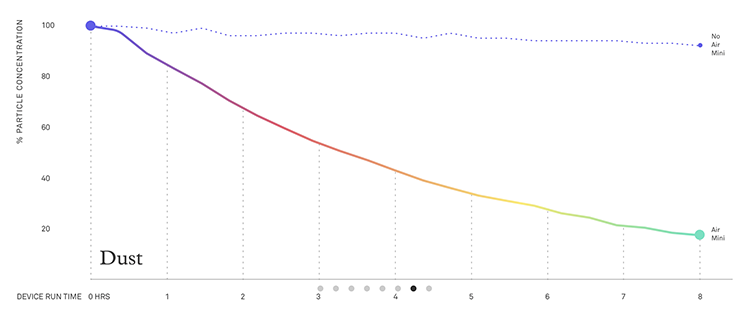
As shown above in a graph published on the brand's website, Molekule has been tested and shown to reduce levels of different airborne contaminants including dust.
The tests were conducted by independent laboratories, but don't appear to be published in any peer-reviewed scientific journals, which is the gold standard for product research in our opinion.
Here are the results from Molekule's product testing:
- >99% reduction in SARS-CoV-2 (the virus that causes COVID-19)
- ~80% reduction in dust
- ~95% reduction in fragrance
- ~80% reduction in smoke
- ~70% reduction in pollen
Based on the available research, we do consider Molekule to be possibly effective at reducing indoor contaminants.
Molekule vs. HEPA Purifiers
We consider Molekule to be potentially effective for reducing indoor air contamination, but how does the brand compare to other devices in the same category?
Consumer Reports tested Molekule and compared its efficacy to other air purifiers. They ranked Molekule 45th out of 48 air purification devices, and their research indicated the device wouldn’t be very effective in rooms larger than 100 square feet.
Wirecutter, which is a review publication run by the New York Times, also ranked Molekule as the worst air purifier they tested.
Their tests found that Molekule was less effective than standard air purifiers. The New York Times actually got Molekule to retract statements of efficacy about their device after submitting a complaint to the National Advertising Division. See the below video for more:
Based on the available research, we do not consider Molekule likely to be superior to any other air purifier brand, and we consider the brand to be a waste of money given its increased relative cost.
How Does Molekule Work?
Molekule leverages a technology called photoelectrochemical oxidation (PECO) that destroys pollutants, rather than trapping them like High Efficiency Particulate Air (HEPA) filters which is the technology used in most air purifiers.
Theoretically, this system is more effective than HEPA filters because it can reduce levels of gaseous contaminants, while HEPA can’t.
Below is a video Molekule published explaining how their PECO technology works:
Molekule vs. Popular Purifier Brands
Here's how Molekule compares to other popular air purifier brands in terms of potential efficacy and healthiness, in our opinion:
Blueair
One of the top air purifier brands for a reason, Blueair sells HEPA-certified filters which have been shown in independent testing to significantly reduce airborne contaminants.
We consider Blueair more likely to be effective, and many of their models are sold at a substantially lower price to Molekule.
Winner: Blueair
AirDoctor
AirDoctor uses industry-standard HEPA filtration technology.
Based on Consumer Reports' analysis, we consider this brand more likely to be effective than Molekule for typical indoor contaminants, and independent testing found AirDoctor to be equally effective against COVID particles, as we documented in our Air Doctor reviews article.
Winner:
Clarifion
This device uses ionization techonlogy, which can be effective but can release ozone, which is harmful to human health.
Winner: Molekule
Molekule Pros and Cons
Pros:
- Novel technology
- May support lung and cardiovascular health
- Future models may outperform HEPA filters
- Sleek design
- Can destroy COVID virus
- May be superior to HEPA filters for gaseous contaminants
Cons:
- More expensive than average air purifier
- Third-party tests show it to be less effective than HEPA
- Removed questionable health claims after NYT investigation
- May not be effective in large rooms
- Unclear value proposition